


Rules of the Day
2-23-2026
Click here for a copy of the lectures notes I wrote in class
Click here for a copy of the handouts I used in class today
Featured Golden Rule of Chemistry: 10. A reaction mechanism describes the sequence of steps occurring during a reaction.10. A reaction mechanism describes the sequence of steps occurring during a reaction.
When learning mechanisms, the key to "catching the wave" is to always ask yourself WHY each step happens the way it does. When you start understanding the answers to that question at each step, the whole thing will make sense.
You should keep a few things in mind when writing these complex mechanisms to make sure you are not making any mistakes: 1) Identify the bonds to be made and broken 2) Avoid "mixed media errores". In acid all intermediates are positively-charged/neutral, in base all intermediates are negatively-charged/neutral, in neutral solution the intermediates can be positvely-charged or negatively-charged 3) Proton transfers are fast 4) Evaluate properties of intermediates to predict next step.10
1. Esters require acid catalysis or base promotion to hydrolyze. These are the reactions used to make soap or biodiesel from triglycerides (the glycerol triester of fatty acids).
2. It is best to hydrolyze esters in base and amides in acid, although either will hydrolyze in acid or base.
3. Acid chlorides, anhydrides, and esters (need heat) react with amines involving an initial attack to create a zwitterionic tetrahedral intermediate, followed by a proton transfer, followed by loss of the leaving group to give the amide.
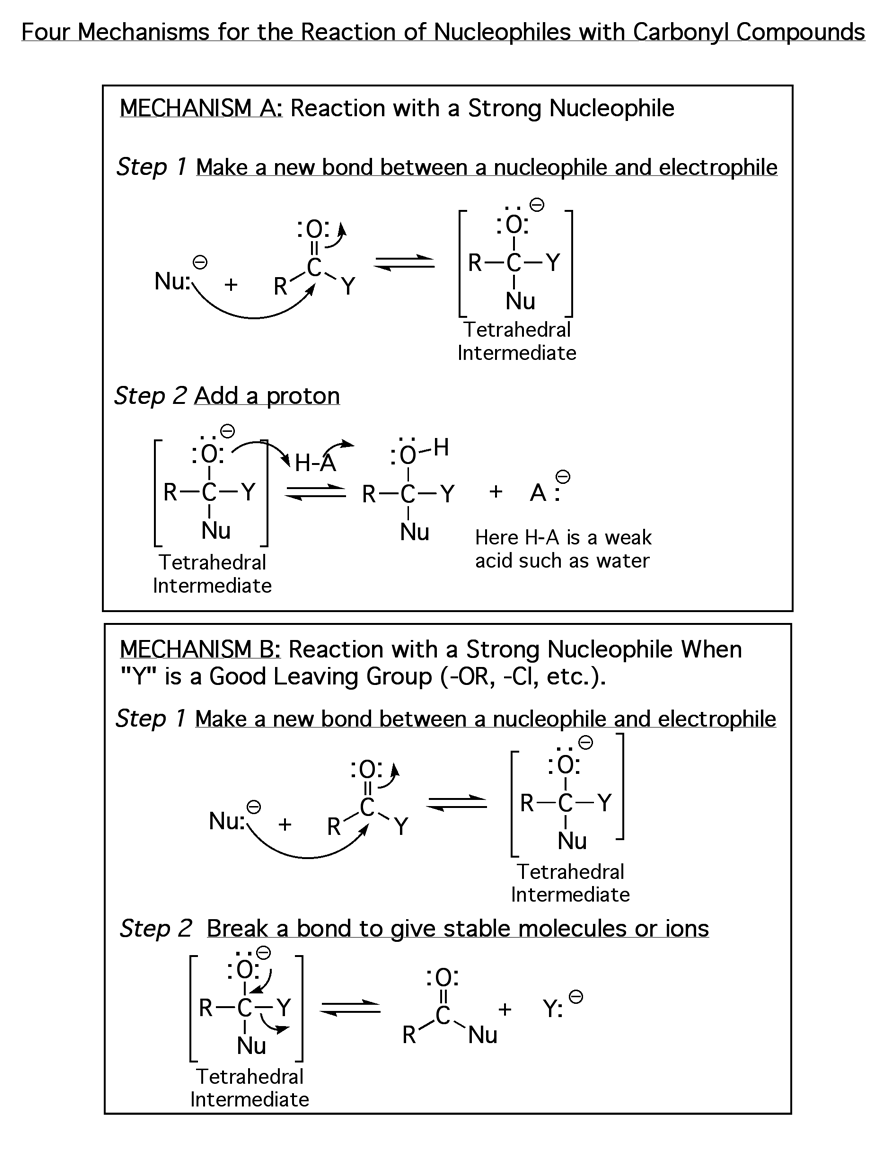
4. Esters react with Grignard reagents twice to give tertiary alcohols. The reaction occurs through Mechanism B followed by Mechanism A, with a ketone produced inbetween.
5. Esters react with LiAlH4 then H2O to give two alcohol molecules through a mechanism that can be described as Mechanism B followed by Mechanism A with an aldehyde formed inbetween. Click here for an animated illustration of the mechanism on a mechanism sheet. Note how this is the same mechanism as the reactions of esters with Grignard reagents, only with different nucleophiles (alkyl group vs. hydride).
6. Acid chlorides react with Gilman reagents to create ketones.
7. The Grignard/esters as well as acid chlorides/Gilmans are very specific with regard to the carboxylic acid derivative and reagents used. Do not "mix and match" reagents with different types of carboxylic acid derivatives.
8. A special reagent called DIBALH (diisobutyl aluminum hydride) can be used to reduce esters that stops at the aldehyde stage due to steric hindrance caused by the two isobutyl "antlers".
9. Amides react with LiAlH4 to give amines. The mechanism is Mechanism B in which the -OAlH3 leaves!!! followed by H- attack of a C=N bond. Remember to think of LiAlH4 as a nucleophilic H- attached to the Lewis acid AlH3.
Homework:
Read: Sections 18.8-18.11 in the ebook textbook. This text is part of the Longhorn Textbook access program.
Take the Daily Quiz 10 before 10 PM tomorrow. Click here to access the quiz. These quizzes are designed to review the important material from today's lecture.
Continue working on Homework 5, that will be due Wednesday, February 25 at 10 PM. There are both Aktiv learning and Gradescope problem sets.
Click here to get the Aktiv Homework Problem Set 5
Click here for the Gradescope Homework Problem Set 5
To submit your homework log onto "Gradescope" on the menu bar of the class Canvas page, or you can Click here to get there directly.